CompVLA: A Variable Compliance Vision-Language-
Action Model for Contact-rich Manipulation

Conference on Robot Learning (CoRL) 2026
Jongmin Kim1*, Junsu Ha1*, Che-Sang Park1*, Minchang Song1, Hyeokju Jeong1, Himchan Hwang1, Jianlong Fu2, Frank C. Park1†
1Seoul National University, 2Microsoft Research Asia
*Equal contribution, †Corresponding author

Seoul National University Robotics Laboratory Microsoft

CompVLA predicts motion together with a time-varying stiffness and virtual displacement. A shorter ellipsoid radius means lower stiffness along that direction: stiff in free space, compliant where contact requires it.

Abstract

Contact-rich manipulation, requiring robots to regulate not only motion but also how they yield to external forces, has emerged as the next frontier for Vision-Language-Action (VLA) models. However, existing VLAs output purely kinematic commands, degrading performance on real-world contact-rich tasks. In this paper, we introduce CompVLA, a unified VLA framework that jointly predicts motion and stiffness matrix from RGB and language inputs. Our approach augments the conventional architecture with a dedicated Compliance Expert, which outputs time-varying stiffness and virtual displacement profiles executed via geometric impedance control. We demonstrate that CompVLA achieves the highest average success rate across diverse contact-rich tasks, outperforming both vanilla and compliance-aware VLA baselines, with ablations confirming each component is essential.

Why Variable Compliance Control for VLAs?

Most VLAs execute trajectories through position control and do not model the force exchanges that arise during contact. A position controller tracks the commanded pose regardless of contact, so a small error in the predicted contact geometry leads to task failure. Aim slightly above the surface and the robot loses contact: the gripper slips off the pivoting board. Aim slightly below and it applies excessive force, damaging the object or triggering the safety stop.

Contact loss. The gripper loses contact during pivoting.

Excessive force. The robot pushes into the surface until the safety stop triggers.

Compliance control resolves this by letting the end-effector behave like a spring: it yields from the commanded pose in proportion to the contact force, so the robot stays in contact and the force stays bounded. A uniformly soft robot, however, tracks free-space motion poorly. The robot therefore needs variable compliance, stiff in free space and compliant only where contact occurs. Hand-tuning such profiles does not scale, so CompVLA learns them from demonstrations.

CompVLA: VLA with Directional Compliance & Force Modulation

Directional Compliance. The robot stays stiff in the plane of motion while remaining compliant along the contact normal.

Force Modulation. The robot modulates the contact force through the stiffness and the displacement between the reference pose and the virtual target.

Compliance-aware Action Representation

At each timestep the policy predicts a motion chunk \( \mathcal M_t = (m_t, \dots, m_{t+T-1}) \), where each token is $$ m_t = (\mathcal V_t,\, g_t,\, k_t,\, d_t). $$ \( \mathcal V_t \in \mathbb R^6 \) is the reference TCP twist and \( g_t \) the gripper command. The diagonal stiffness \( k_t = [k^R_t; k^p_t] \in \mathbb R^6 \) sets how the robot yields along each axis, and the virtual displacement \( d_t = [d^R_t; d^p_t] \in \mathbb R^6 \) both orients the compliance frame (directional compliance) and shifts the target pose to generate a contact force (force modulation).

Dual-expert Architecture

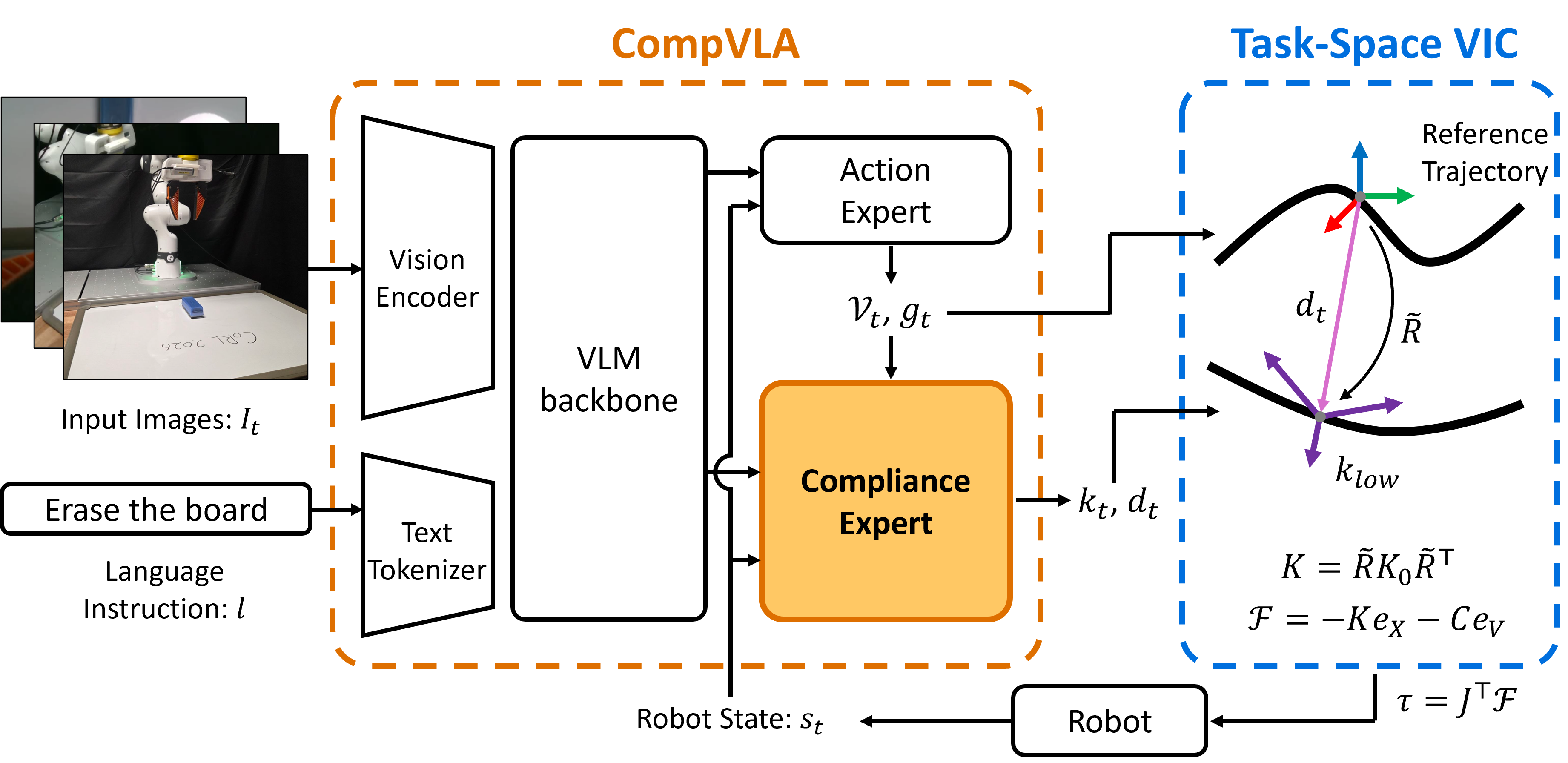
CompVLA builds on a \( \pi_0 \) backbone (PaliGemma VLM) with two experts attached through cross-attention. The Action Expert predicts the reference TCP twist and gripper command. Its integrated trajectory conditions the Compliance Expert, which predicts \( k_t \) and \( d_t \). Both experts are trained jointly with flow matching, \( \mathcal L = \mathcal L_a + \mathcal L_c \), where \( \mathcal L_a \) and \( \mathcal L_c \) are the flow-matching losses of the Action Expert and the Compliance Expert, respectively.

CompVLA framework and geometric impedance controller

Overall framework of CompVLA and the geometric impedance controller.

Real-world Experiments

We evaluate on a 7-DoF Franka Research 3 with three RealSense cameras. Force/torque readings are recorded for training labels only and are not used by the policy at evaluation time. Three contact-rich tasks span the regimes where compliance matters: surface tracking under pose uncertainty (Erase Whiteboard), continuously varying compliance direction (Pivot), and force-regulated pressing (Cup Dispense). A Pick and Place task checks that standard manipulation is preserved.

Erase Whiteboard

Pivot

Cup Dispense

Pick & Place

Success Rates

MethodContact-richStandard
ErasePivotCup DispenseAveragePick & Place
\( \pi_0 \)17.8 ± 7.131.7 ± 10.438.0 ± 12.129.2 ± 9.280.0 ± 10.0
ForceVLA68.1 ± 4.145.0 ± 15.050.0 ± 8.754.4 ± 4.345.0 ± 15.0
TA-VLA52.8 ± 9.726.7 ± 10.40.0 ± 0.026.5 ± 2.083.3 ± 12.6
CompVLA (ours)92.9 ± 3.773.3 ± 10.435.0 ± 10.067.1 ± 7.276.7 ± 5.8
DP0.00.010.03.350.0
ACT0.015.030.015.00.0

Success rate (%), mean ± standard deviation. CompVLA achieves the highest average across the contact-rich tasks while remaining comparable to \( \pi_0 \) on Pick and Place.

Contact-rich Demonstration Dataset

We release the demonstrations used to train CompVLA: 100 episodes per task, collected with a force-feedback leader–follower teleoperation system. Each episode contains three camera views, joint positions, joint torques, and wrist force/torque readings, synchronized at 10 Hz and stored in the LeRobot format.

Citation

@article{kim2026compvla,
  title={CompVLA: A Variable Compliance Vision-Language-Action Model for Contact-rich Manipulation},
  author={Kim, Jongmin and Ha, Junsu and Park, Che-Sang and Song, Minchang and Jeong, Hyeokju and Hwang, Himchan and Fu, Jianlong and Park, Frank C},
  journal={arXiv preprint arXiv:2609.23614},
  year={2026}
}